
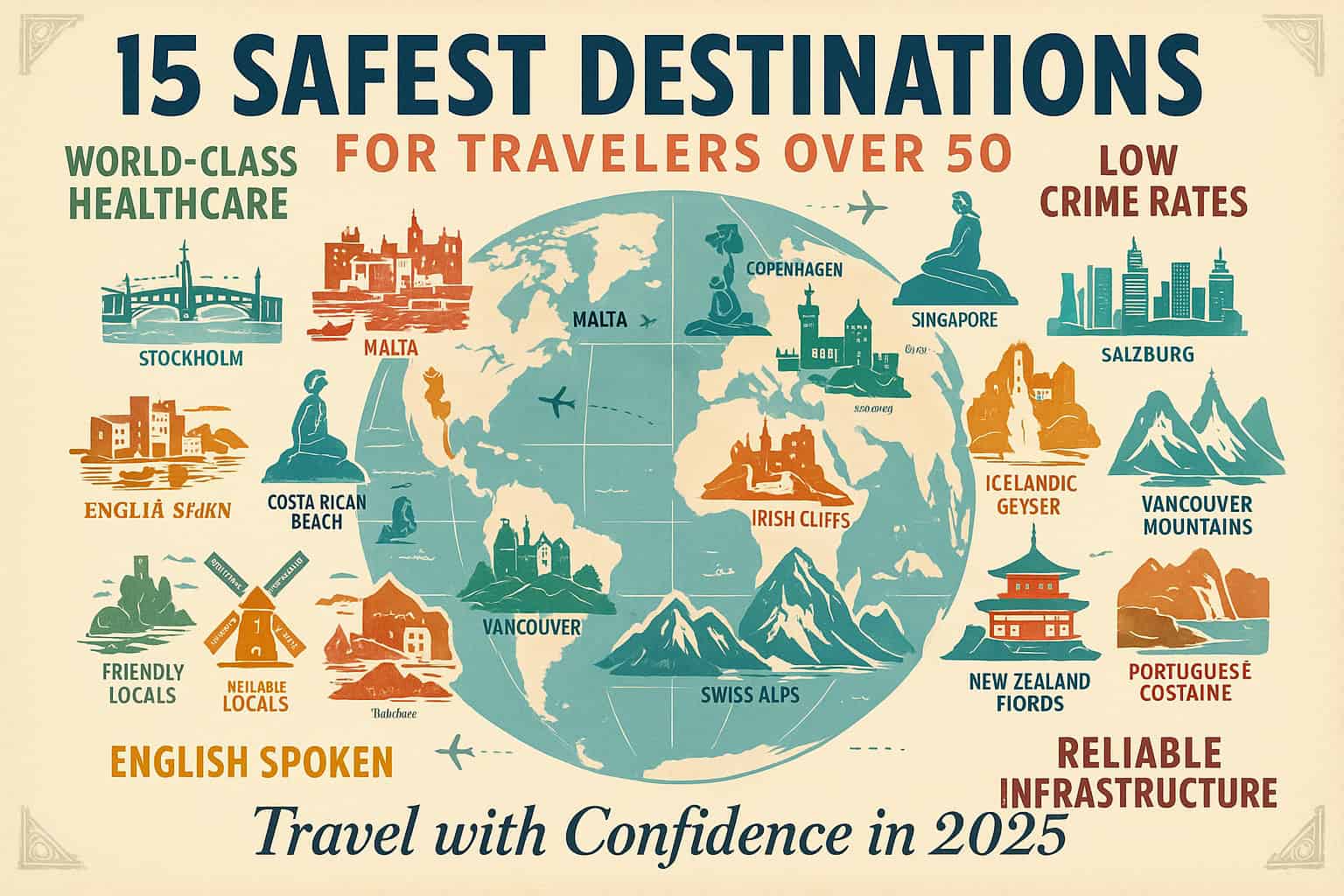
Forget backpacks and youth hostels—modern travelers over 50 want adventure with actual comfort and real safety. The good news? The world offers incredible destinations where you can explore confidently without constantly looking over your shoulder.

The Caribbean for Less Than You Think
Up to 65% off + a resort credit + a free night at select Sandals resorts. 8 islands. 17 resorts. All-inclusive everything. See the deals →
From Nordic cities that run like clockwork to Mediterranean islands where locals treat you like family, these 15 international spots deliver rich experiences plus the security and infrastructure that let you focus on memories, not mishaps.
Stick around for the #1 destination at the end—it’s sunny, affordable, and safer than most American suburbs.
15. Sweden’s Stockholm – Elegant Yet Approachable
Stockholm carries itself with quiet confidence across 14 islands connected by bridges that showcase genuine craftsmanship. The Swedes have mastered something rare—sophistication without stuffiness.
Their crime rates rank among the lowest in Europe, and the streets maintain a cleanliness that would impress even the most particular visitors. The city’s efficient public transportation system includes buses, trains, and ferries that connect seamlessly, making navigation straightforward even for first-time visitors.
Most Stockholmers speak excellent English, eliminating language barriers that complicate travel in other European capitals.
14. Malta – A Sunny Mediterranean Gem
This Mediterranean island between Sicily and North Africa offers something modern destinations often lack—genuine respect for experienced travelers. Malta’s official languages include English, a legacy of British rule that makes communication effortless. No fumbling with translation apps or playing charades at the pharmacy here.
The cost of living runs approximately 20-30% lower than the United States, with rental prices on the charming island of Gozo significantly more affordable than most American cities. Malta offers special residency programs for retirees, including tax incentives and streamlined visa processes.
The island maintains a relaxed Mediterranean pace while providing modern amenities and excellent healthcare facilities. The warm climate year-round means comfortable exploration without extreme heat or cold.
13. Costa Rica’s Guanacaste – Tropical Paradise with Modern Safety
Guanacaste proves that tropical destinations can prioritize visitor safety without sacrificing natural beauty. This Costa Rican province stretches along the Pacific coastline with beaches that remain remarkably clean and well-maintained.
Local authorities work actively to keep crime rates low in tourist areas, with visible police presence in popular destinations. Liberia International Airport sits in the heart of Guanacaste, offering direct flights from major U.S. cities and eliminating lengthy ground transfers.
The dry season from December through April provides consistently sunny weather with minimal rainfall. Costa Rica abolished its military in 1948 and redirected those funds to education and healthcare, creating a stable, peaceful society. The country’s “Pura Vida” philosophy emphasizes relaxed, friendly living that welcomes visitors warmly.
12. Denmark’s Copenhagen – A Fairy-Tale City Built on Safety
Copenhagen consistently ranks as one of the world’s safest cities in the Economist Intelligence Unit’s Safe Cities Index, excelling in digital security, health measures, infrastructure, and personal security. This Danish capital earned its reputation through comprehensive urban planning and strong social systems. Crime rates remain remarkably low, while clean streets and efficient public transport reflect genuine civic pride.
Copenhagen’s fairy-tale charm extends beyond tourist marketing—it’s built into cobblestone streets, timber-framed buildings, and well-preserved royal palaces. The city blends historical architecture with modern Scandinavian design, creating an atmosphere that feels both timeless and contemporary. Solo travelers find Copenhagen particularly welcoming, with locals who speak excellent English and public transportation that runs with precision. The extensive bike lane network allows easy, safe exploration at a comfortable pace.
11. Singapore – Tiny But Mighty in Safety and Cleanliness
This island nation maintains streets so clean they gleam, backed by strict enforcement of public cleanliness laws. Singapore’s government operates with efficiency that produces tangible results—functioning infrastructure, minimal corruption, and genuine public safety. Crime rates rank among the world’s lowest, allowing travelers to explore freely day or night without concern. The entire city-state feels meticulously organized, with everything in its designated place.
English serves as one of four official languages, making communication straightforward. The MRT (Mass Rapid Transit) system connects the entire island with air-conditioned trains that arrive precisely on schedule. Healthcare facilities meet international standards, with many doctors trained in Western countries.
The hawker centers offer affordable, delicious food in clean, regulated environments. Singapore’s tropical location means warm weather year-round, though humidity can be intense.
10. Austria’s Salzburg – Where Castles and Calm Coexist
Salzburg welcomes older travelers with medieval streets that don’t demand marathon walking or mountain climbing expertise. The city’s compact historic center allows easy exploration on foot, with most major attractions within comfortable walking distance.
The Hohensalzburg Fortress, built in 1077, sits perched above the town offering stunning views accessible by funicular railway—no treacherous climbing required. Mozart’s birthplace maintains straightforward navigation, with baroque architecture that speaks a universal language of beauty.
The Salzburg Card provides unlimited public transport and free admission to major attractions, simplifying logistics. Austrian efficiency means trains and buses run on time, and English is widely spoken in tourist areas. The city’s size makes it manageable without feeling overwhelming, perfect for travelers who prefer intimate destinations over sprawling metropolises.
9. Ireland’s Galway – Welcoming as Sunday Dinner
Galway delivers gentle adventure without the chaos of Dublin crowds. This compact coastal city wraps visitors in traditional Irish hospitality that feels genuinely warm rather than commercially scripted. The streets hum with live music from corner pubs, where impromptu traditional sessions happen nightly.
Unlike sanitized entertainment districts, Galway’s music scene flows naturally from authentic local culture. Getting around requires nothing more than pleasant strolls through colorful neighborhoods lined with shops, cafes, and pubs. The city’s walkable size means no complicated subway systems or confusing ride-sharing apps. Locals treat visitors like welcomed guests, readily offering directions and recommendations.
The nearby Cliffs of Moher and Connemara region provide stunning scenery within easy day-trip distance. Ireland’s temperate climate means mild weather year-round, though rain gear remains essential.
8. Netherlands – Bike Paths Smoother Than Silk
The Dutch built something remarkable with their cycling infrastructure. Over 35,000 kilometers of dedicated bike paths crisscross the country, separated from vehicle traffic and maintained to high standards.
These aren’t sidewalk cracks masquerading as cycling lanes—they’re purpose-built routes that prioritize cyclist safety and comfort. In the 1970s, the Netherlands faced over 3,000 annual traffic deaths despite a population of only 13 million. Public protests and smart policy decisions transformed Dutch roads into cycling paradise.
Today, older travelers can pedal through Dutch cities without dodging cars or navigating obstacle courses. Cities like Amsterdam, Utrecht, and Haarlem offer flat terrain perfect for leisurely cycling. Bike rental shops provide comfortable city bikes with upright seating positions. The cycling culture means drivers expect and respect cyclists, creating a safe environment for two-wheeled exploration.
7. Australia’s Tasmania – Rugged Beauty with Remarkable Safety
Tasmania sits 150 miles south of mainland Australia, offering a heart-shaped refuge with exceptional safety statistics. This island maintains crime rates that rank among Australia’s lowest, with violent crime particularly rare.
More than 40% of Tasmania remains protected wilderness, providing untouched natural beauty for adventurous travelers. The island’s compact size makes exploration manageable, with Hobart serving as a charming base.
Tasmania’s temperate climate offers four distinct seasons, with summer (December-February) providing the most comfortable weather for outdoor activities. The island’s isolation has preserved unique wildlife and ecosystems found nowhere else on Earth. Excellent healthcare facilities in Hobart and Launceston provide peace of mind for travelers.
The local population maintains a friendly, laid-back attitude that welcomes visitors warmly. Fresh seafood, local wines, and farm-to-table dining create a food scene that rivals larger Australian cities.
6. Iceland – The World’s Most Peaceful Country
Iceland has topped the Global Peace Index for over a decade, consistently ranking as the world’s safest and most peaceful country. This isn’t marketing hype—it’s backed by measurable data on crime rates, political stability, and social safety.
Crime rates remain extraordinarily low, making midnight walks through Reykjavik safer than daytime strolls in many world capitals. The country maintains no standing army, with a small coast guard handling security needs. Iceland’s small population of around 370,000 creates a tight-knit society where community values remain strong. Most Icelanders speak excellent English, eliminating language barriers.
The dramatic landscapes—geysers, waterfalls, glaciers, and volcanic formations—provide stunning scenery accessible via well-maintained roads. The famous Icelandic horses roam freely, embodying the peaceful coexistence that characterizes the entire country. Healthcare meets high European standards, with modern facilities in Reykjavik.
5. Japan’s Kyoto – Ancient Charm Meets Modern Safety
Kyoto operates with precision that would impress any efficiency expert. This former imperial capital delivers safety standards that make even cautious travelers comfortable. The city treats older visitors with genuine respect deeply rooted in Japanese culture. Streets maintain remarkable cleanliness, and crime rates remain exceptionally low—lost wallets are typically returned with contents intact.
Ancient temples and bamboo groves come with modern conveniences that actually function properly. Public transportation runs exactly on schedule, with clear English signage throughout the system. The city’s grid layout makes navigation straightforward, unlike Tokyo’s maze-like streets. Kyoto’s numerous temples and gardens rarely require strenuous climbing, with many offering accessible routes.
The slower pace compared to Tokyo or Osaka allows comfortable exploration without feeling rushed. Japanese hospitality (omotenashi) means service staff genuinely care about visitor comfort and satisfaction.
4. Canada’s Vancouver – Friendly and Fully Equipped
Vancouver treats older travelers with genuine respect and comprehensive accessibility. Public transportation actually works here—the SkyTrain runs smoothly and reliably, while buses feature low-floor boarding for easy access.
The system covers the entire metro area with clear signage and helpful staff. Healthcare won’t create financial emergencies for travelers. Walk-in clinics throughout the city provide quality care, and Canada’s healthcare system offers reasonable costs even for visitors.
Many clinics accept international travel insurance directly. The locals maintain genuine politeness, with “please” and “thank you” still standard practice. English is the primary language, though Vancouver’s multicultural population means many languages are spoken. The city’s natural setting between mountains and ocean provides stunning scenery accessible via well-maintained parks and seawall paths. The mild climate means comfortable exploration year-round, with less extreme weather than eastern Canada.
3. Switzerland – Healthcare Excellence Meets Alpine Beauty
Switzerland operates a healthcare system that consistently ranks among the world’s best. Every resident carries mandatory health insurance, but unlike government-run systems elsewhere, Switzerland uses regulated private insurers to provide coverage. This creates a system that blends universal access with private sector efficiency.
Swiss hospitals maintain exceptional standards with cutting-edge equipment and highly trained multilingual staff. Most doctors speak English fluently along with German, French, or Italian depending on the region. For older travelers, this means world-class medical care is always accessible. Switzerland’s infrastructure extends beyond healthcare—trains run precisely on schedule, connecting even remote mountain villages. The country’s legendary cleanliness and organization make navigation straightforward.
Four official languages (German, French, Italian, and Romansh) reflect Switzerland’s cultural diversity, though English is widely understood in tourist areas. The stunning Alpine scenery provides breathtaking backdrops, with cable cars and mountain railways making high-altitude views accessible without strenuous hiking.
2. New Zealand’s South Island – Pristine Paradise
New Zealand’s South Island delivers safety that would impress even the most security-conscious travelers. Crime rates remain remarkably low, with many rural areas where locals still leave doors unlocked. The biggest danger travelers face comes from being overwhelmed by stunning scenery—glaciers, fjords, mountains, and pristine lakes stretch endlessly without commercial clutter.
The landscapes maintain a cleanliness and preservation that reflects New Zealand’s strong environmental values. Emergency services function efficiently across the island, with well-equipped hospitals in major centers like Christchurch, Queenstown, and Dunedin.
The healthcare system provides quality care, with many doctors trained in Australia, the UK, or North America. New Zealanders (Kiwis) are famously friendly and helpful, treating visitors with genuine warmth. English is the primary language, making communication effortless. The South Island’s diverse geography means varied experiences within manageable distances—from wine regions to adventure capitals to tranquil coastal towns.
1. Portugal’s Algarve Coast – Sunshine and Safety Combined
The Algarve delivers sunshine over 300 days annually with remarkable consistency. This southern slice of Portugal treats older travelers like honored guests, offering beaches that stretch for miles without overwhelming crowds.
Safety here feels natural rather than forced—Portugal consistently ranks as one of Europe’s safest countries, with the Algarve maintaining particularly low crime rates. The Portuguese genuinely believe in treating visitors with respect and warmth. The weather stays mild year-round, with winter temperatures rarely dropping below 60°F and summer heat moderated by ocean breezes.
The cost of living runs significantly lower than most Western European destinations, with excellent restaurants offering fresh seafood at reasonable prices. Portugal’s healthcare system provides quality care at affordable rates, with many doctors speaking English. The Algarve’s infrastructure caters well to older travelers, with accessible beaches, well-maintained sidewalks, and reliable public transportation connecting coastal towns.
The region offers diverse experiences from historic villages to world-class golf courses to dramatic cliff-side walks.
What Makes a Destination Safe for Seasoned Travelers?
Today’s safety considerations extend far beyond avoiding pickpockets and checking crime statistics. Modern seasoned travelers need destinations with robust healthcare systems, genuinely helpful locals, and cities designed for actual navigation rather than digital dependency. The safest destinations combine low crime rates with excellent infrastructure, quality medical care, and cultural attitudes that respect older visitors.
Health Services and Accessibility
Smart travelers know that accessible healthcare abroad isn’t a luxury—it’s essential insurance. Countries like Switzerland and Singapore built their medical reputations through decades of consistent excellence, not flashy marketing. These destinations offer doctors who speak multiple languages fluently because they actually learned them in medical school, not through translation apps. Key healthcare features include 24/7 English-speaking medical staff at major hospitals, prescription medication availability without bureaucratic nightmares, ambulance response times under 10 minutes in most European capitals, and travel insurance acceptance without requiring legal expertise to understand coverage. Countries like Denmark and Australia maintain medical facilities where “bedside manner” remains a priority, with healthcare workers who believe in explaining procedures clearly rather than mumbling medical jargon.
Local Friendliness and Cultural Attitudes
The safest destinations feature locals who haven’t forgotten basic human decency. In places like New Zealand and Canada, asking for directions still gets helpful responses instead of blank stares. These countries cultivate genuine hospitality—not scripted customer service that sounds committee-written. Locals actually make eye contact and offer real assistance. Signs of authentic friendliness include shopkeepers who remember regular customers, taxi drivers who know their cities without GPS dependency, restaurant staff who explain menus patiently, and pedestrians who acknowledge each other’s existence. Countries like Ireland and Portugal maintain cultures where helping visitors isn’t considered an inconvenience. Their locals grew up understanding that courtesy costs nothing but creates everything.
Easy Navigation and Infrastructure
The safest destinations for seasoned travelers feature logical city layouts that weren’t designed by committee. Places like Vienna and Tokyo maintain public transportation systems that actually make sense. These cities still use clear street signage in multiple languages—not tiny print requiring reading glasses and magnifying glasses, but actual readable signs that respect human eyesight. Navigation essentials include numbered street systems following logical patterns, reliable public transit with posted schedules that are actually accurate, pedestrian-friendly crosswalks with reasonable timing, and tourist information centers staffed by humans rather than kiosks. Countries like Germany and Japan built infrastructure when engineers prioritized functionality over flashiness. Their cities work for people who remember when getting around town didn’t require a technology degree.
Practical Travel Tips for Modern International Exploration
Today’s transportation systems favor plastic cards over exact change, modern luggage demands wheels instead of strong backs, and communication happens through satellites rather than operator assistance. These shifts require different strategies for travelers adapting to current technology while maintaining their travel independence.
Mastering Modern Transportation Systems
Modern public transportation runs on apps and contactless payments instead of paper tickets and friendly conductors. Travelers should download transportation apps 2-3 days before departure and load them with payment methods. Most major cities now use tap-to-pay systems accepting credit cards or phones directly. Essential transportation prep includes downloading city transit apps before leaving home, ensuring credit cards work internationally (call your bank to activate international use), screenshot important routes and stops for offline access, and carrying backup cash for older systems that haven’t modernized. Train stations no longer feature large flip-display departure boards—digital screens show information that changes quickly. Arrive 15-20 minutes early to locate platforms and gates without rushing.
Rideshare services like Uber operate differently than traditional taxis. The app shows driver photos, car details, and estimated arrival times. Payment happens automatically through the app, eliminating cash transactions and tipping confusion. Many drivers expect passengers to identify them rather than vice versa—look for the car make, model, and license plate shown in your app. Airport security now requires removing electronics larger than phones from carry-on bags. Liquids must fit in clear, quart-sized bags with containers no larger than 3.4 ounces. Wear shoes that slip off easily and avoid belts with large metal buckles to speed through security screening.
Smart Packing for Modern Travel
Modern luggage features four spinner wheels instead of two, allowing travelers to roll bags upright beside them rather than dragging them behind. This reduces strain on shoulders and backs during long airport walks. Hard-shell suitcases protect belongings better than soft-sided bags but weigh more when empty. Weigh packed bags at home using bathroom scales to avoid airline fees—most international flights allow 50 pounds for checked bags, though budget carriers may have lower limits. Smart packing essentials include compression cubes to maximize space and organize clothing by type, portable phone chargers with multiple ports to keep devices powered, universal power adapters with USB outlets for multiple countries, and copies of important documents (passport, insurance, prescriptions) stored separately from originals.
Clothing made from synthetic fabrics or merino wool dries faster than cotton, which matters for hand-washing items in hotel sinks or dealing with unexpected weather. Merino wool offers natural odor resistance for longer wear between washes. Shoes should be broken in for at least two weeks before travel—many European cities feature cobblestone streets that challenge ankles and feet. Comfortable walking shoes with good arch support prevent fatigue during long sightseeing days. Bring at least two pairs to alternate daily, allowing shoes to dry and air out. Prescription medications should stay in original bottles with pharmacy labels clearly visible. Pack extra supplies in case of delayed returns—most doctors recommend bringing 50% more than your trip length requires. Travel insurance often covers prescription replacements but requires proper documentation.
Staying Connected in the Digital Age
International phone plans now cost $10-15 per day with major U.S. carriers, a significant improvement over old roaming charges of $3-4 per minute. Most carriers offer temporary international packages—call your phone company at least 3-5 days before departure to add international service and ensure it activates properly. Some carriers like T-Mobile and Google Fi include international data in their regular plans at no extra cost. WiFi appears in most hotels, restaurants, and public spaces throughout developed countries. However, public networks pose security risks for banking or shopping. Use your phone’s hotspot feature or rent portable WiFi devices for secure connections when accessing sensitive information.
Communication setup checklist includes adding international calling and data to your phone plan, downloading offline maps for major destinations (Google Maps allows this), installing WhatsApp for free international messaging (most popular globally), and writing down important phone numbers on paper as a backup. Video calls through WhatsApp, FaceTime, or Skype work better than traditional international calls because these apps use internet connections instead of phone networks, avoiding expensive per-minute charges. Emergency contact information should include local embassy numbers, travel insurance hotlines, and country-specific emergency numbers. Many countries use different emergency numbers than 911—for example, 112 works throughout Europe. Save these numbers in your phone and write them on paper as backup.
Banking apps often block transactions from foreign countries as automatic fraud protection. Notify banks about travel dates and destinations at least one week before departure. Most banks allow this through their mobile apps, websites, or by calling customer service. Bring at least two different credit cards from different banks in case one gets blocked or lost. Inform your bank if you plan to withdraw cash from ATMs abroad—international ATM fees typically range from $3-5 per transaction, plus potential currency conversion fees of 1-3%.
Understanding Travel Insurance for International Trips
Travel insurance transforms from optional to essential for international trips, especially for travelers over 50. Medical emergencies abroad can create financial catastrophes without proper coverage, and standard health insurance rarely covers international medical care. Understanding what travel insurance actually covers and which policies provide real value requires cutting through marketing language to find genuine protection.
What Travel Insurance Should Actually Cover
Comprehensive travel insurance should include emergency medical coverage of at least $100,000, though $250,000 provides better protection for serious incidents. This covers hospital stays, emergency procedures, and ambulance transport. Emergency medical evacuation coverage is crucial—medical flights can cost $50,000-$100,000 or more. This benefit transports you to the nearest adequate medical facility or back home if medically necessary. Trip cancellation and interruption coverage reimburses non-refundable expenses if you must cancel or cut short your trip due to covered reasons like illness, injury, or family emergencies. Baggage loss and delay coverage provides reimbursement for lost luggage and essential purchases if bags are delayed more than 12-24 hours.
Pre-existing condition coverage requires careful attention. Most standard policies exclude pre-existing medical conditions unless you purchase insurance within 10-21 days of making your first trip payment and meet other requirements. Some policies offer pre-existing condition waivers that provide coverage if you buy early and your condition is stable. 24/7 emergency assistance services connect you with English-speaking representatives who can locate doctors, arrange hospital admissions, coordinate evacuations, and handle logistics during medical emergencies. This service alone justifies travel insurance costs for many older travelers.
Choosing the Right Travel Insurance Policy
Compare policies from multiple providers rather than accepting the first option offered by booking websites or travel agents. Independent comparison sites like Squaremouth or InsureMyTrip show multiple policies side-by-side, making it easier to evaluate coverage and costs. Read the full policy document, not just the summary—exclusions and limitations hide in the fine print. Pay attention to coverage limits, deductibles, and specific exclusions that might affect your situation. Annual multi-trip policies make financial sense for travelers taking multiple international trips per year. These policies cover unlimited trips up to a certain length (typically 30-90 days per trip) for one annual premium, usually costing less than buying separate policies for each trip.
Consider “Cancel for Any Reason” (CFAR) coverage if you want maximum flexibility. Standard trip cancellation only covers specific listed reasons like illness or natural disasters. CFAR allows cancellation for any reason and typically reimburses 50-75% of non-refundable costs. This coverage costs 40-60% more than standard policies and must usually be purchased within 10-21 days of your initial trip deposit. Adventure sports and activities often require additional coverage. Standard policies may exclude injuries from activities like skiing, scuba diving, or hiking at high altitudes. Purchase supplemental coverage if your trip includes these activities.
Managing Medications and Health Needs Abroad
Managing prescriptions and health needs internationally requires advance planning that goes beyond simply packing pill bottles. Different countries have different regulations, availability, and naming conventions for medications that can create challenges if you’re unprepared. Understanding how to handle your health needs abroad prevents minor issues from becoming major problems.
Preparing Medications for International Travel
Keep all prescription medications in original pharmacy-labeled bottles showing your name, medication name, dosage, and prescribing doctor. This documentation proves legitimacy at customs and helps foreign pharmacists identify medications if you need refills. Some countries restrict certain medications that are legal in the United States—controlled substances like ADHD medications, anxiety medications, and strong pain relievers require extra documentation. Check the embassy website for your destination country to verify your medications are legal and learn what documentation is required. Carry a letter from your doctor on official letterhead listing all medications, dosages, and medical conditions. This letter should use generic drug names (not just brand names) since brand names vary internationally.
Pack medications in carry-on luggage, never checked bags. Checked luggage can be lost, delayed, or exposed to temperature extremes that damage medications. Bring at least 50% more medication than your trip length requires—if you’re traveling for two weeks, bring three weeks’ worth. This buffer protects against unexpected delays, lost pills, or extended trips. Organize medications in a clear, labeled pill organizer for daily use, but keep original bottles accessible for customs and emergencies. Research pharmacy availability at your destination. Major cities worldwide have well-stocked pharmacies, but rural areas may have limited options. Know the generic names of your medications—pharmacists can often provide equivalents even if the exact brand isn’t available.
Handling Medical Needs During Your Trip
Locate English-speaking doctors and hospitals before you need them. Your hotel concierge, embassy, or travel insurance company can provide recommendations. Many international hospitals have special departments for foreign patients with English-speaking staff. Save these contact numbers in your phone and write them on paper as backup. Understand how to access medical care in your destination country. Some countries allow direct hospital visits, while others require seeing a general practitioner first. Know whether you need to pay upfront and file insurance claims later, or if your insurance provides direct billing.
Carry a basic medical information card with your blood type, allergies, current medications, and emergency contacts in both English and the local language if possible. Medical ID bracelets or necklaces provide this information even if you’re unconscious. Research common health issues at your destination. Some regions have altitude sickness concerns, others have water quality issues, and some have disease risks requiring vaccinations or preventive medications. Prepare appropriately based on your specific destination and health status. Pack a basic first-aid kit with bandages, antibiotic ointment, pain relievers, anti-diarrheal medication, and any over-the-counter medications you use regularly. These items may be difficult to find or expensive abroad.
Frequently Asked Questions About Safe International Travel for Seniors
Do I need special vaccines for these destinations? Vaccine requirements vary by destination. European countries, Canada, Australia, New Zealand, Japan, and Singapore generally require no special vaccines beyond routine immunizations. Costa Rica recommends hepatitis A and typhoid vaccines, though they’re not required. Always check the CDC’s travel health website for current recommendations specific to your destinations at least 4-6 weeks before departure, as some vaccines require multiple doses over several weeks. Your doctor can review your vaccination history and recommend any needed updates. Most destinations on this list are developed countries with excellent sanitation and healthcare, minimizing disease risks.
How much does travel insurance typically cost for seniors? Travel insurance for travelers over 50 typically costs 5-10% of total trip costs, though prices increase with age and pre-existing conditions. For a $5,000 two-week international trip, expect to pay $250-$500 for comprehensive coverage including medical, evacuation, trip cancellation, and baggage protection. Travelers over 70 often pay 8-12% of trip costs due to higher medical risks. Pre-existing condition waivers and “Cancel for Any Reason” coverage add 40-60% to base premiums. Annual multi-trip policies for frequent travelers typically cost $400-$800 depending on age and coverage levels, potentially saving money compared to buying separate policies for each trip.
What if I have mobility limitations or use a wheelchair? Many destinations on this list accommodate mobility limitations well. European cities like Copenhagen, Amsterdam, and Vienna have excellent accessibility with ramped sidewalks, accessible public transit, and wheelchair-friendly attractions. However, historic areas with cobblestone streets and older buildings may present challenges. Japan offers exceptional accessibility in major cities with elevators at most train stations and accessible facilities. Singapore maintains universal accessibility standards throughout the city-state. Research specific accessibility features at your destination—many tourism boards provide detailed accessibility guides. Contact hotels directly to verify room accessibility beyond standard descriptions. Consider hiring private drivers or accessible tour companies for easier transportation than public transit.
Should I exchange currency before leaving or use ATMs abroad? Using ATMs abroad typically provides better exchange rates than airport currency exchanges or exchanging cash before departure. Withdraw larger amounts less frequently to minimize ATM fees (usually $3-5 per transaction). Notify your bank about travel plans to prevent card blocks. Bring two different ATM/debit cards from different banks in case one gets blocked, lost, or damaged. Exchange $100-200 before departure for immediate needs like taxis or tips upon arrival, but rely on ATMs for most cash needs. Credit cards often offer the best exchange rates for purchases, though some merchants add 2-3% surcharges for credit cards. Check if your credit cards charge foreign transaction fees (typically 3%)—many travel rewards cards waive these fees.
How do I handle language barriers in countries where English isn’t common? Most destinations on this list have high English proficiency—Scandinavia, Netherlands, Singapore, and Malta have English speakers nearly everywhere. In countries with less English (Portugal, Austria, Japan), tourist areas typically have English-speaking staff at hotels, restaurants, and attractions. Download Google Translate app with offline language packs before departure—it translates text, speech, and even images of signs or menus. Learn basic phrases in the local language (hello, thank you, excuse me, where is, how much)—locals appreciate the effort even if your pronunciation is imperfect. Carry your hotel’s business card with address in local language for showing taxi drivers. Consider hiring English-speaking guides for complex activities or day trips.
What’s the best way to stay connected with family back home? WhatsApp provides the easiest free communication internationally—it works over WiFi or data for messaging, voice calls, and video calls. Download it before departure and ensure family members have it too. FaceTime works well for Apple device users. Facebook Messenger offers similar features. These apps use internet connections instead of phone networks, avoiding international calling charges. Set up a regular check-in schedule with family (daily or every few days) so they know you’re safe without constant communication. Share your itinerary with trusted family members including hotel names, addresses, and phone numbers. Consider buying an international data plan or portable WiFi device for constant connectivity beyond hotel WiFi.
Are guided tours better than independent travel for seniors? This depends on personal preferences, mobility, and comfort with independent travel. Guided tours offer convenience, pre-arranged logistics, knowledgeable guides, and built-in companionship. They work well for travelers who prefer structured schedules and minimal planning. However, tours move at group pace, offer less flexibility, and cost more than independent travel. Independent travel provides freedom to explore at your own pace, choose your own activities, and adjust plans spontaneously. It requires more planning and problem-solving but offers more authentic experiences and better value. Consider a hybrid approach—book guided day tours for complex activities or unfamiliar areas while maintaining independent control over your overall itinerary and accommodations. Small group tours (8-16 people) often provide better experiences than large bus tours.
Making Your International Travel Dreams Reality
The world offers remarkable destinations where seasoned travelers can explore confidently, comfortably, and safely. From Portugal’s sunny Algarve coast to New Zealand’s pristine South Island, from Japan’s efficient cities to Iceland’s peaceful landscapes, these destinations prove that international travel after 50 can be the most rewarding travel of your life. The combination of life experience, available time, and financial stability that comes with age creates perfect conditions for meaningful international exploration. Modern infrastructure, excellent healthcare systems, and genuine cultural hospitality in these destinations remove the barriers that once made international travel challenging for older adults. The key lies in choosing destinations that align with your interests, comfort level, and health needs while providing the safety and accessibility that allow you to focus on experiences rather than worries. Start planning your next international adventure—the world is waiting, and it’s safer and more accessible than ever before.